Viking Art (Arte Vikingo)
David Wilson / Ole Klindt Jensen
Editorial George Allen & Unwin
1966
En inglés
Tapa dura, sin sobrecubierta original
171 páginas
Profusamente ilustrado
Impreso en Londres (Reino Unido)
✶ ESTADO: 9/10. Impecable estado.
Sin la sobrecubierta original. Ejemplar en perfecto estado.
✶ SINOPSIS:
INTRODUCCIÓN
En este libro hemos intentado trazar la historia del arte de los vikingos, un pueblo que sus contemporáneos consideraban bárbaro. Nuestra historia toca apenas una faceta de una rica cultura que afectó a toda la Europa noroccidental y, ya se interprete a los vikingos como bárbaros o como civilizadores, el arte que dejaron tras de sí tiene una originalidad y una estatura sin par en la Europa del período comprendido entre 800 y 1100. Un gran historiador resumió la impresión que el arte vikingo deja en la mente moderna:
“Hoy, entre tantos recordatorios de aquellas edades heroicas, los museos del norte conservan en sus vitrinas sorprendentes cantidades de oro y plata: en gran parte producto del comercio, sin duda; pero también mucho de ello, como observó el sacerdote alemán Adán de Bremen, ‘frutos del pillaje’. Es un hecho llamativo que esos metales preciosos, robados o recibidos como tributo, a veces en forma de monedas, a veces como joyería de tipo occidental, hayan sido por lo común rehechos en adornos conformes al gusto de sus nuevos dueños, prueba de una civilización singularmente segura de sí misma.”
Hemos tomado estas frases de Marc Bloch como una clave para nuestra comprensión del arte vikingo. La idea de un pueblo “seguro de sí mismo” es, creemos, la clave del arte vikingo.
Aunque ha habido mucha discusión acerca de las influencias presentes en el arte vikingo, hubo pocos intentos de registrar su contenido. Cada elemento ornamental de cada estilo fue analizado y cada matiz fue rastreado hasta una fuente hipotética; pero los rastros son tan tenues y las teorías resultantes tan variadas que resulta difícil lograr una imagen nítida de los principales elementos que componían ese arte. Creemos que la influencia principal en el arte vikingo fue la tradición artística escandinava. No negamos que haya influencias extranjeras presentes en el arte, en algunos períodos son muy aparentes, pero creemos que un examen detenido y crítico del material que sobrevivió indica que en todos los casos esas influencias no fueron simplemente incorporadas al arte de Escandinavia, sino que quedaron rápidamente sumergidas en él por un pueblo seguro de su gusto.
Aunque éste es el tema del libro, esperamos que no se imponga de manera demasiado visible en lo que confiamos sea una descripción e historia del arte vikingo razonablemente sobria y meditada, porque nuestro propósito principal fue presentar el contenido del arte; nuestra interpretación de ese contenido es secundaria respecto de ese propósito principal, y hemos tratado de evitar toda alegación interesada.
En este sentido, la autoría conjunta de este libro ha sido de gran ventaja para las dos personas implicadas, y la razón de esta colaboración debe explicarse aquí, porque constituye una de las principales justificaciones para la presentación de esta historia. El problema nodal en las discusiones pasadas sobre cada fase del arte vikingo fue decidir el alcance de la influencia insular y continental en el desarrollo estilístico. En un intento por alcanzar un verdadero equilibrio académico, los estudiosos británicos, irlandeses, alemanes y escandinavos se inclinaron hacia atrás para evitar cargos de chauvinismo. Nos pareció que la única manera de lograr un equilibrio adecuado era que un escandinavo y un británico estudiaran juntos el tema. Hemos escrito distintas partes del libro, pero en todas las etapas nos consultamos mutuamente y cada uno tradujo el trabajo de su coautor a su lengua materna, un método de análisis tan severo como cualquiera ideado en un estudio humano. Coincidimos en la mayoría de los puntos y tratamos de que nuestro argumento fuera coherente, pero si hay contradicciones ocasionales pediríamos a nuestros críticos que recuerden que esto es una colaboración.
El doctor Christiansson presentó hace poco un resumen de los cambios de ideas en torno al arte vikingo. No hace falta repetir aquí en detalle su reseña, porque su libro es de fácil acceso, pero ciertos aspectos de la historia del pensamiento sobre el tema son esenciales si queremos apreciar las sutilezas del arte vikingo. Desde 1880, cuando Sophus Müller presentó su clásica obra introductoria sobre el ornamento animal escandinavo, muchos estudiosos intentaron explicar las influencias que componían el arte de los vikingos, entre ellos Salin, Shetelig, Brøndsted, Lindqvist, Åberg, Arbman, Kendrick, Arwidsson, Forssander, Holmqvist y Bertil Almgren. Ninguno de هؤلاء estudiosos dedicó un libro exclusivamente a una historia directa del arte del período vikingo; todos se interesaron por un aspecto particular del arte vikingo y la imagen que emerge de sus estudios es la de tres corrientes distintas de pensamiento, que interpretan el arte vikingo como derivado de fuentes (a) insulares, (b) carolingias o (c) orientales. Pocos estudiosos subrayaron las cualidades indígenas del arte vikingo, que los autores del presente libro creen inherentes a la naturaleza confiada en sí misma de la sociedad vikinga y que resultan más probables por la falta de paralelos satisfactorios para los diversos estilos vikingos en Europa occidental y en Oriente. El profesor Lindqvist fue el primero en destacar este elemento indígena en el arte, en uno de los poquísimos contextos en que se requería una historia directa del arte vikingo. Un reciente y magistral estudio panorámico del mismo tema por el profesor Arbman, aunque menos explícito, implica una visión similar.
Existe entre los arqueólogos una extraordinaria renuencia a reconocer rasgos culturales originales en su propio país, y esto es particularmente cierto para el período vikingo, porque los estudiosos están obsesionados por el hecho de que los mercaderes, piratas y aventureros vikingos penetraron en todos los rincones del mundo conocido y trajeron consigo a sus patrias septentrionales bienes, costumbres y recuerdos. Este costado dramático de la historia vikinga tiñó todos los aspectos del estudio de la civilización vikinga y los estudiosos tendieron a usar ese color en su estudio del arte. Vieron el arte como un producto de las aventuras vikingas en el extranjero, cuyos elementos habrían sido importados junto con los esclavos y el vino que los piratas y los mercaderes llevaban de regreso a Escandinavia. Es fácil olvidar que, durante el período vikingo, hubo una continuidad de cultura en Escandinavia, la continuidad de una sociedad agrícola con su demanda de lo aceptado y lo familiar. Sólo en ese contexto de una sociedad estable puede entenderse el arte vikingo, porque esas influencias extranjeras que se introducían en el país por medio de los vikingos que regresaban fueron adaptadas de inmediato a un idioma nativo por artesanos que rara vez, si es que alguna vez, salieron de Escandinavia. Estos hombres viajaban con sus mercancías de la granja de un pequeño jefe a la siguiente, o trabajaban en sus casas produciendo objetos para los intermediarios; conocían el gusto de sus clientes y adaptaban su arte a él.
Este aspecto estable de la cultura vikinga fue descuidado por los historiadores de su arte, porque los primeros pasos en el estudio del tema se dieron en una época de romanticismo en torno de las aventuras vikingas, y también en un período en el que el darwinismo se aplicaba a los objetos tanto como a los organismos. Los estudios histórico-artísticos sobre el arte vikingo crecieron en la atmósfera de las teorías tipológicas de Oscar Montelius, cuyo discípulo, Bernhard Salin, tocó el arte vikingo en su clásico estudio tipológico del ornamento animal, Die altgermanische Thierornamentik. Los métodos usados por Salin fueron empleados por casi todos los historiadores posteriores del arte vikingo. Así como Salin investigó toda Europa en un intento de explicar el crecimiento del ornamento animal desde el final del período romano hasta alrededor del 800, sus sucesores, particularmente Snetelig y Åberg, sintieron que les incumbía usar métodos similares para explicar el arte vikingo. Lo analizaron y luego buscaron orígenes para sus componentes originales, pero al hacerlo perdieron de vista en ocasiones el objetivo principal de su estudio, la comprensión de la totalidad del arte vikingo. Aunque el análisis y el examen del origen de rasgos individuales son imprescindibles para el estudio de cualquier arte, lo que importa es el arte en su conjunto. Shetelig y sus sucesores sentaron una base con su análisis, sobre la cual debe apoyarse todo estudio moderno, pero, si examinamos el arte completo en su marco nativo, vemos que parecen haber subestimado la originalidad y la continuidad de la cultura vikinga y del arte vikingo.
En este libro tenemos una gran deuda con nuestros predecesores en el estudio. Sin su estudio exacto y minucioso, no podríamos en modo alguno intentar resumir esta faceta de la civilización vikinga. A esta distancia temporal, sin embargo, podemos permitirnos tomar distancia del combate general de ideas, que alcanzó su clímax a fines de la década de 1930 con el trabajo de Arbman, Kendrick, Arwidsson, Forssander y Åberg, e intentar una valoración del arte en su conjunto a la luz de sus discusiones.
Sólo un estudioso moderno intentó abordar el arte vikingo de una manera distinta de la de sus predecesores. En su brillante estudio del arte vikingo, Bertil Almgren trató de ofrecer un enfoque analítico diferente mediante el examen de las curvas, conscientes e inconscientes, usadas por el artista vikingo al construir su patrón. El método es un estudio interesante de uno de los posibles rasgos de la mente que guían la mano del artista, pero no puede aplicarse a un estudio general de este tipo, porque tiende a ser a la vez demasiado particular y demasiado subjetivo. Sólo un estudioso trató de adoptar el esquema de Almgren para un estudio del arte vikingo, y aun así sólo como método complementario, pero los resultados que produjo no fueron concluyentes.
Los métodos usados en este libro, por lo tanto, son los métodos analíticos y comparativos ya probados de nuestros predecesores; por la propia naturaleza del material estamos limitados del mismo modo que ellos lo estuvieron, pero tenemos una ventaja que ellos no tenían a su disposición, un conocimiento de sus hechos y teorías cuidadosamente elaborados, y eso es lo que intentamos cribar y ajustar a una imagen que algunos encontrarán poco original, pero que creemos se ajusta a los hechos.
Uno de los propósitos primarios de este libro fue erigir una secuencia cronológica para el arte vikingo. No es una tarea fácil, porque un estilo no muere de repente para ser reemplazado al día siguiente por un estilo completamente distinto: los estilos se superponen y se prolongan, se deslizan suavemente unos dentro de otros y no hay un solo punto en el que uno pueda trazar una línea y etiquetar un estilo de un lado como “Ringerike” y el del otro como “Urnes”. Los estilos no sólo se superponen, también pueden ser contemporáneos, Borre y Jellinge, por ejemplo. La distinción entre motivo y estilo es importante en el arte vikingo, porque da cuenta de muchas anomalías aparentes; podemos ver, por ejemplo, en un mismo objeto de Gotland, animales de “Estilo E” junto a “bestias que se aferran”. Sin embargo, creemos que puede construirse algún tipo de cuadro cronológico y, al hacerlo, nuestro método debe quedar expuesto.
En nuestro intento de construir esta cronología partimos de lo conocido y avanzamos hacia lo desconocido pasando por lo parcialmente conocido. Nuestro punto de partida fue el material bien fechado, que se divide en dos encabezamientos: “datación personal” y “datación por monedas”. Bajo el primer encabezamiento incluimos objetos cuya fabricación está fechada por una inscripción que remite a un acontecimiento o personaje histórico conocido, por ejemplo la piedra de Jellinge o la Cruz de Cong. Este tipo de objetos es más común hacia el final de nuestro período y prácticamente desconocido en su comienzo.
Las monedas proporcionan un segundo método de datación. Cuando un objeto es depositado en un tesoro de monedas, la fecha de depósito queda indicada por la fecha de la moneda más reciente encontrada en el tesoro; eso constituye una fecha útil para el objeto, en tanto marca la fecha más tardía posible en que pudo haber sido hecho. Hoy las monedas pueden fecharse con tal precisión que algunos de los resultados de este método son bastante notables. La mayoría de nuestras fechas posteriores a 925 están confirmadas, o sugeridas, por evidencia monetaria. Este método sólo se aplica a objetos hallados en tesoros que contienen un cuerpo considerable de monedas. Es imposible fechar una tumba por este método cuando se encuentran una o dos monedas entre los demás objetos funerarios. Del mismo modo, es obvio que ciertos objetos ya eran viejos cuando fueron colocados en el tesoro; sin embargo, la provisión de una fecha dentro de la vida de un objeto reduce a la mitad el margen de error cronológico, mientras que la presencia de varios tesoros que contienen objetos decorados en un estilo similar permite usar juicios estadísticos sencillos de probabilidad de fecha.
Cuando todo el material de datación de este tipo ha sido cribado, recurrimos a juicios más subjetivos, por ejemplo a la datación basada en probabilidad política. Las primeras cruces de Man y las esculturas del este de Yorkshire de comienzos del siglo IX fueron fechadas en este libro según la probable situación política vigente en las Islas Británicas en un momento dado. Pero en la mayoría de los casos estos métodos fueron usados en asociación con métodos primarios de datación, por ejemplo material procedente de tesoros de monedas, o bien con métodos secundarios bastante más fiables, como la comparación de un estilo vikingo con un estilo que lo influye, o influido por él, en un contexto bien fechado fuera de Escandinavia, como ocurre, por ejemplo, con ciertos estilos previkingos de Vendel.
El método de último recurso, y el menos fiable desde un punto de vista cronológico, es la tipología, por la cual se considera que un estilo se desarrolla o degenera y se construye un marco cronológico relativo ajustado al proceso observado. La cronología relativa de un objeto lograda por este método se ve a veces confirmada por su asociación recurrente con otros objetos, que también fueron dispuestos en secuencias tipológicas. Éste es, sin embargo, un método subjetivo, y uno que usamos con mucha cautela cuando todos los demás métodos han fallado. Estos métodos son los métodos arqueológicos normales desarrollados por los prehistoriadores.
El material disponible para este estudio no es representativo, porque el arte aquí registrado es principalmente arte aplicado, por lo general ornamento animal, y tiene una importancia secundaria respecto del objeto que decoraba. El propósito primario de un broche es servir como cierre de vestido o capa; el ornamento de los apliques en la empuñadura de la espada es secundario respecto del propósito de esa arma. En unos pocos casos tenemos ejemplos de arte en el sentido primario, arte por el arte mismo, pero son sorprendentemente pocos, una pieza de escultura aislada y una cantidad de objetos que podrían clasificarse bajo el encabezamiento ars sacra. Este libro relata, entonces, la historia de una serie de estilos del arte decorativo de los pueblos vikingos. Podemos hacer pocos de esos juicios exclamativos que los historiadores de las artes del Renacimiento, por ejemplo, pueden hacer; sólo podemos cumplir nuestra función como atribucionistas arqueológicos y catalogar los rasgos del arte que estudiamos. Por último, no podemos discutir cada objeto ornamentado, ni siquiera cada tipo de ornamento, pero confiamos en que todo problema importante sea tocado o aclarado en el ensayo que sigue: el material usado es el que nos parece más importante y, si hemos usado material familiar para el estudiante, es porque forma la clave del estudio.
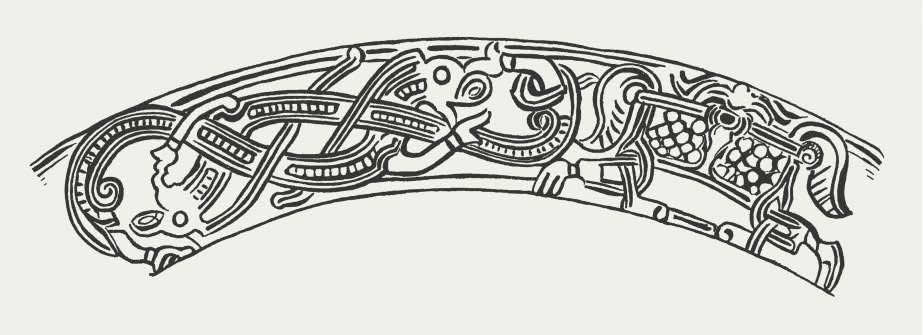 Imagen reproducida en esta edición
INTRODUCTION (Original)
In this book we have attempted to outline the history of the art of the Vikings—a people who were considered by their contemporaries to be barbarians. Our history touches but one facet of a rich culture which affected the whole of north-western Europe and, whether the Vikings are interpreted as barbarians or civilizers, the art which they left behind them has an originality and a stature second to none in Europe of the period from 800–1100. A great historian has summarized the impression which Viking art leaves on the modern mind:
“Today, among so many reminders of those heroic ages, the museums of the north preserve in their glass cases surprising quantities of gold and silver: largely the proceeds of commerce, no doubt; but much of it also, as the German priest Adam of Bremen remarked, “fruits of brigandage”. It is a striking fact that these precious metals stolen or received as tribute, sometimes in the form of coins, sometimes as jewellery of the western type, should usually have been refashioned into trinkets conforming to the taste of their new owners—evidence of a civilization singularly sure of itself.”
We have taken these sentences of Marc Bloch as a key to our understanding of Viking art. The idea of a people ‘sure of itself’ is, we believe, the clue to Viking art.
Although there has been much discussion concerning the influences present in Viking art, there have been few attempts to record its content. Every single ornamental element of each style has been analysed and every nuance has been traced to a hypothetical source; but the traces are so tenuous and the resulting theories so varied that it is difficult to achieve any clear-cut picture of the main elements which made up the art. It is our belief that the main influence in Viking art was the Scandinavian artistic tradition. We do not deny that foreign influences are present in the art—at some periods they are very apparent—but we believe that a close and critical examination of the material which survives indicates that in every case these influences were not merely taken into the art of Scandinavia, but were quickly submerged in it by a people sure of their taste.
While this is the theme of the book, we hope that it does not obtrude too noticeably in what we trust is a reasonably sober and considered description and history of Viking art, for our main purpose has been to present the content of the art—our interpretation of that content is secondary to our main purpose and we have tried to avoid special pleading.
In this respect the joint authorship of this book has been of great advantage to the two individuals concerned, and the reason for this collaboration must be explained here, for it forms one of the main excuses for the presentation of this history. The nodal problem in past discussions of each phase of Viking art has been to decide the extent of insular and Continental influence in the stylistic development. In an attempt to achieve true scholarly balance students, British, Irish, German, and Scandinavian, have leant over backwards to avoid charges of chauvinism. We felt that the one way to achieve a proper balance was by a Scandinavian and a Briton pursuing a study of the subject together. We have written different parts of the book, but at all stages we have consulted each other and each has translated his co-author’s work into his native language—a method of analysis as severe as any devised in a human study—we have agreed on most points and we have tried to make our argument coherent, but if there are occasional contradictions we would ask our critics to remember that this is a collaboration.
A recent summary of the changing ideas concerning Viking art has been presented by Dr Christiansson. It is unnecessary to repeat his resumé in detail here, for his book is readily accessible, but certain facets of the history of thought on the subject are essential if we are to appreciate the niceties of Viking art. Since 1880, when Sophus Müller presented his classic introductory work on Scandinavian animal ornament, many scholars have tried to explain the influences which made up the art of the Vikings, among them Salin, Shetelig, Brøndsted, Lindqvist, Åberg, Arbman, Kendrick, Arwidsson, Forssander, Holmqvist, and Bertil Almgren. Not one of these scholars has devoted a book exclusively to a straight history of the art of the Viking period, all were interested in a particular aspect of Viking art and the picture that emerges from their studies is of three distinct schools of thought, which interpret Viking art as derivative from (a) Insular (b) Carolingian, or (c) Eastern sources. Few scholars have emphasized the indigenous qualities of Viking art, which the present authors believe to be inherent in the self-confident nature of the Viking society and which is made more likely by the lack of satisfactory parallels for the various Viking styles in western Europe and in the East. Professor Lindqvist was the first to stress this indigenous element in the art, in one of the very few contexts where a straight history of Viking art was required. A recent masterly survey of the same subject by Professor Arbman, while not so explicit, implies a similar view.
There is an extraordinary reluctance among archaeologists to recognize any original cultural traits in their own country and this is particularly true of the Viking period, for scholars are obsessed by the fact that the Viking merchants, pirates and adventurers, penetrated every corner of the known world and brought back with them goods, customs and souvenirs to their northern homelands. This dramatic side of Viking history has coloured all aspects of the study of Viking civilization and scholars have tended to use this colour in their study of the art. They have seen the art as a product of the Viking adventures abroad—its elements having been imported with the slaves and the wine which were brought back to Scandinavia by the pirates and the merchants. It is easy to forget that, during the Viking period, there was a continuity of culture in Scandinavia—the continuity of an agricultural society with its demand for the accepted and familiar. It is only in this context of a stable society that Viking art can be understood, for such foreign influences as were brought into the country by the returning Vikings were immediately adapted to a native idiom by craftsmen who rarely, if ever, moved out of Scandinavia. These men travelled with their wares from the farm of one petty chieftain to the next, or worked at home producing objects for the middlemen; they knew the taste of their customers and adapted their art to it.
This stable aspect of Viking culture has been neglected by the historians of its art, because the first steps in the study of the subject were taken at a period of romanticism concerning the Viking adventures, and at a period when Darwinism was being applied to objects as well as organisms. Viking art-historical studies grew up in the atmosphere of the typological theories of Oscar Montelius, whose pupil, Bernhard Salin, touched on Viking art in his classic typological study of animal ornament, Die altgermanische Thierornamentik. The methods used by Salin have been used by nearly all subsequent historians of Viking art. As Salin investigated all Europe in an attempt to explain the growth of animal ornament from the end of the Roman period to c. 800, so his successors (particularly Snetelig and Åberg) felt it incumbent on them to use similar methods to explain Viking art. They analysed it and then sought origins for its original components, but in so doing they occasionally lost sight of the main aim of their study—the understanding of the totality of Viking art. Although analysis and examination of the origin of individual features are imperative to the study of any art, it is the whole art that matters. Shetelig and his successors laid a groundwork by their analysis, on which all modern study must be based, but, if we examine the whole art in its native setting, we see that they appear to have underestimated the originality and continuity of Viking culture and of Viking art.
In this book we owe a great debt to our predecessors in the study—without their accurate and minute study we could not possibly attempt to summarize this facet of Viking civilization. At this distance of time, however, we can afford to stand back from the general struggle of ideas, which reached its climax in the late 1930s with the work of Arbman, Kendrick, Arwidsson, Forssander and Åberg, and attempt an estimate of the whole art in the light of their discussions.
Only one modern scholar has attempted to tackle Viking art in a way different from his predecessors. In his brilliant study of Viking art Bertil Almgren has attempted to provide a different analytical approach to the art by the examination of the curves, conscious and unconscious, used by the Viking artist in constructing his pattern. The method is an interesting study of one of the possible traits of the mind which guide the hand of the artist, but the method cannot be applied to a general study of this sort, as it tends to be at once too particular and too subjective. Only one scholar has tried to adopt Almgren’s scheme to a study of Viking art, and then only as a supplementary method, but the results he produced were not conclusive.
The methods used in this book therefore, are the tried analytical and comparative methods of our predecessors; by the very nature of the material we are limited in the same way that they were limited, but we have one advantage that was not available to them—a knowledge of their carefully worked out facts and theories, and these we have tried to sift and tailor to a picture that some will find far from original, but which we believe to fit the facts.
One of the primary purposes of this book has been to erect a chronological sequence for Viking art. This is no easy task, for one style does not die suddenly to be replaced on the next day by a completely different style—styles overlap and linger on, they run softly into each other and there is no one place where one can draw a line and label a style on one side ‘Ringerike’, and the style on the other ‘Urnes’. Not only do styles overlap, they can also be contemporaneous (Borre and Jellinge for example). The distinction between motif and style is an important one in Viking art, for it accounts for many apparent anomalies—we may see, for example, on the same Gotlandic object, ‘Style E’ animals alongside ‘gripping-beasts’ (e.g. pl. xxv e). Nevertheless we believe that some sort of chronological picture can be constructed and our method in so doing must be exposed.
In our attempt to construct this chronology we have started from the known and moved to the unknown by way of the partially known. Our starting point has been the well-dated material, which comes under two heads: ‘personal dating’ and ‘coin dating’. Under the former heading we include objects the manufacture of which is dated by an inscription referring to a known historical event or personage—e.g. the Jellinge stone (pl. xxviii) or the Cross of Cong (pl. lxxvi). Such objects are more common towards the end of our period and are practically unknown at its beginning.
Coins provide a second method of dating. When an object is deposited in a hoard of coins the date of deposition is indicated by the date of the latest coin found in the hoard; this forms a useful date for the object as the latest possible date at which it could be made. Coins can now be so accurately dated, that some of the results of this method are quite remarkable. Most of our dates after 925 are confirmed, or suggested, by coin evidence. This method only applies to objects found in hoards which contain a considerable body of coins. It is impossible to date a grave by this method when one or two coins are found amongst the other grave goods. Similarly it is obvious that certain objects were old when placed in the hoard; nevertheless, the provision of one date in the life of an object cuts down the margin of chronological error by half, while the occurrence of a number of hoards containing objects decorated in a similar style allows one to use simple statistical judgments of probability of date.
When all dating material of this sort has been sifted, we fall back on more subjective judgments, dating on political probability, for example. The early Manx crosses, and the early ninth century sculptures of east Yorkshire, have been dated in this book by the probable political situation pertaining in the British Isles at a given time. But in most cases such methods have been used in association with primary methods of dating—by coin hoard material, for example—or by rather more reliable secondary methods, such as the comparison of a Viking style with a style influencing it, or influenced by it, in a well-dated context outside Scandinavia, as, for example, with certain of the pre-Viking, Vendel styles.
The method of last resort, and the least reliable method from a chronological point of view, is typology: whereby a style is seen to develop or degenerate and a relative chronological framework is constructed to fit the process observed. The relative chronology of an object achieved by using this method is sometimes confirmed by its recurrent association with other objects, which have also been set in typological sequences. This is, however, a subjective method, and one which we have used with great caution when every other method has failed. These methods are the normal archaeological methods developed by the prehistorians.
The material available for this study is unrepresentative, for the art chronicled here is mainly applied art (usually animal ornament) and is of secondary importance to the object it decorated. The primary purpose of a brooch is as a dress or cloak fastener; the ornament of the mounts on the hilt of the sword is secondary to the purpose of that weapon. In a few cases we have examples of art in the primary sense—art for art’s sake—but these are surprisingly few, an odd piece of sculpture and a number of objects which might be classified under the heading ars sacra. This book relates, then, the history of a number of styles of the decorative art of the Viking peoples. We can make few of the exclamatory judgments which historians of the arts of, for example, the Renaissance can make; we can only fulfil our function as archaeological attributionists and catalogue the features of the art we study. Lastly, we cannot discuss every ornamented object, or even every type of ornament, but we trust that every major problem is touched on or elucidated in the essay that follows: the material used is that which seems to us most important and, if we have used material familiar to the student, this is because it forms the key to the study.
✶ ÍNDICE:
- Prefacio
- Introducción
Primera parte, por Ole Klindt-Jensen
I. Arte escandinavo antes de los vikingos
II. Los primeros estilos vikingos
Segunda parte, por David M. Wilson
III. El estilo Borre
IV. El estilo Jellinge
V. El estilo Mammen
VI. El estilo Ringerike
VII. El estilo
- Epílogo
- Bibliografía
- Índice
English original
Preface
Introduction
Part I by Ole Klindt-Jensen
I. Scandinavian Art before the Vikings
II. The Earliest Viking Styles
Part II by David M. Wilson
III. The Borre Style
IV. The Jellinge Style
V. The Mammen Style
VI. The Ringerike Style
VII. The Urnes Style
Envoy
Bibliography
Index
.jpg)